- Home
- About IAP2
- Resources
- Committees
- Awards
- Careers
- Certificate Training
- Events
- News
- Members
- Contact Us
Resources

Resources > UN Declaration > The United Nations Brisbane Declaration

The United Nations Brisbane Declaration
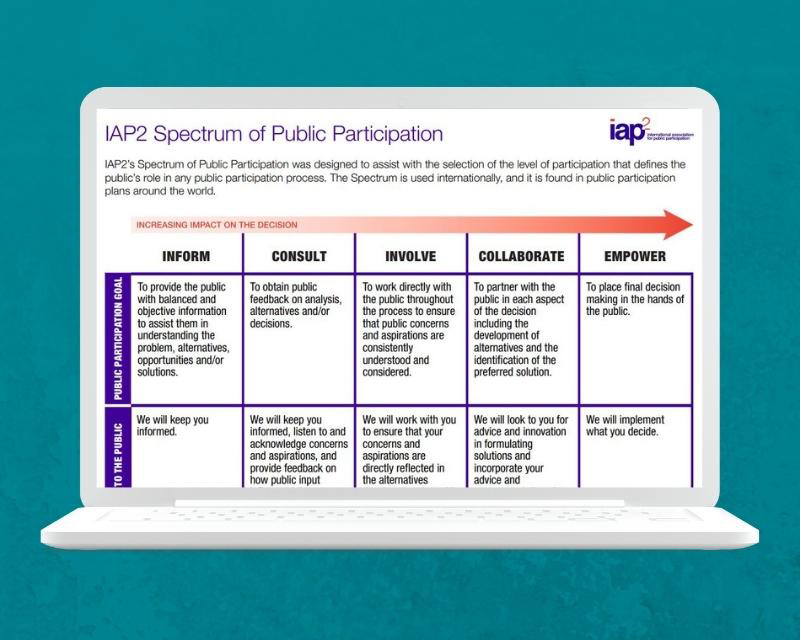
The Brisbane Declaration on community engagement has drawn on a number of sources for global definitions and aspirations for community engagement including the International Association of Public Participation's (IAP2) core values.
A draft of the Declaration was developed in the lead up to the International Conference on Engaging Communities held in Brisbane 14 - 17 August 2005. It was reviewed and revised to reflect the feedback from the community of practitioners, academics, policy advisers, government and citizens who responded to a questionnaire.
Importantly, there were also a number of deliberative sessions on the Declaration held during the conference. Feedback from these sessions has been incorporated into the final version of the Declaration.
The process of developing the Declaration aimed to act as a catalyst for mobilising the global community and developing common understanding, shared visions and goals.
The Brisbane Declaration
We, representatives of countries and communities, including indigenous peoples, international institutions, national, state and local governments, academic institutions, and business and civil society organisations from across the world, participating in the International Conference on Engaging Communities, held in Brisbane, Australia, from 15-17 August 2005,
1. Acknowledge the universal interest and importance of community engagement, founded in the inherent dignity of people and the values, rights and responsibilities of all people expressed in the Universal Declaration on Human Rights.
2. Welcome the Seoul Declaration on Participatory and Transparent Governance in its call for all actors in societies to work together to expand and promote participatory, transparent governance for the benefit of their people.
3. Underscore that community engagement is essential to the achievement of the Millennium Declaration including the Millennium Goals for Development.
4. Express appreciation for the efforts of the United Nations and its specialised agencies in helping to advance the practice of community engagement and support of greater participatory and transparent governance.
5. Express appreciation to the Government of the State of Queensland, to the Indigenous peoples for their welcome to the country, and to all the people of Queensland, Australia for hosting the inaugural International Conference on Engaging Communities.
6. Express appreciation to the other Australian governments, tertiary institutions and organisations that have sponsored and partnered in the organisation of this gathering, to the staff and volunteers, and to all those who have through participation shared their expertise and experience to build greater understanding, capability and commitment to the practice of community engagement.
Community Engagement
7. Affirm that community engagement is critical to effective, transparent and accountable governance in the public, community and private sectors.
8. Recognise that community engagement is a two way process:
• by which the aspirations, concerns, needs and values of citizens and communities are incorporated at all levels and in all sectors in policy development, planning, decision-making, service delivery and assessment; and
• by which governments and other business and civil society organisations involve citizens, clients, communities and other stakeholders in these processes.
9. Affirm that effective engagement generates better decisions, delivering sustainable economic, environmental, social and cultural benefits
10. Also recognise that effective community engagement enables the free and full development of human potential, fosters relationships based on mutual understanding, trust and respect, facilitates the sharing of responsibilities, and crates more inclusive and sustainable communities.
11. Further recognise that meaningful community engagement seeks to address barriers and build the capacity and confidence of people to participate in, and negotiate and partner with, institutions that affect their lives, in particular those previously excluded or disenfranchised.
12. Further recognise that inclusive engagement requires that Indigenous peoples and the poor and marginalized, are adequately resourced to participate meaningfully in the broader community and that they have a stake in the outcome and benefit equitable as a result of being involved.
13. Endorse the core principles of integrity, inclusion, deliberation and influence in community engagement:
• Integrity – when there is openness and honesty about the scope and purpose of engagement;
• Inclusion – when there is an opportunity for a diverse range of values and perspectives to be freely and fairly expressed and heard;
• Deliberation – when there is sufficient and credible information for dialogue, choice and decisions, and when there is space to weigh options, develop common understanding and to appreciate respective roles and responsibilities;
• Influence – when people have input in designing how they participate, when policies and services reflect their involvement and when their impact is apparent.
14. Recognise the availability of a wide range of methods and technologies, including new and emerging tools associated with the internet, to facilitate appropriate and effective community engagement.
15. Affirm the value of education, ongoing monitoring and evaluation, and knowledge sharing about active citizenship and community engagement processes and outcomes.
16. Draws attention to the materials and recommendations of the specialized panels and workshops which supplement this Declaration.
Next steps
The participants from all over the world at this conference:
17. Request the Host Country to bring to the attention of the General Assembly of the United Nations the Declaration of this inaugural International Conference on Engaging Communities so that it may provide leadership globally for its promotion and implementation.
18. Further call on international institutions as well as national, provincial and local governments to give effect to the values and principles of this Declaration.
19. Express support for more dialogue between international institutions and others with the people of the world about issues of global interest, and the availability of digital and other means to support such interaction.
20. Encourage the tertiary sector and other public and professional organisations to facilitate research and teaching, policy and practice development, organisational development, evaluation and networking to sustain the learning’s and connections created at this inaugural International Conference on Engaging Communities.
21. Further encourage the private sector and civil society organisations to implement practical and meaningful ways to be responsive to, representative of, and enabling of the participation of citizens, clients, communities.
22. Note with appreciation the willingness of the Queensland Government to support knowledge-sharing and capacity-building for community engagement and to be involved in the follow-up to this Conference.
23. Request the United Nations, building on the success and legacies of this Conference, to assist countries and communities to foster effective community engagement practices by supporting research and training, and documenting successful outcomes and disseminating these widely.